


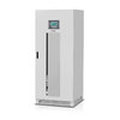
The topology of an ONLINE UPS (the internal design of the UPS) affects how it will perform in different environments. Choosing the right topology is critical and necessary for mission-critical applications. Below, we will discuss the two most common topologies, Line-Interactive and Online, as well as their strengths and weaknesses.
For power ranges greater than 5kVA, line-interactive UPS becomes impractical due to higher cost and larger size. For power below 750VA, online double-conversion UPS is rarely considered because line-interactive and offline structures are more practical for smaller power ranges.
Thus, the comparison and choice between the two topologies, Line-Interactive and Online, mainly focuses on the power range of 750VA to 5kVA. This is where the functions and economic advantages of one topology are not clearly distinguished from the other and depend on the specific installation. While the Line-Interactive type has become the most commonly manufactured topology deployed in this power range, advances in semiconductor technology and manufacturing techniques have made the production cost of the Online type competitive with the Line-Interactive type, making the choice between the two harder.
Understand your application requirements:
Before making any decision about UPS architecture, it is important to understand the requirements of the equipment to be protected and the environment in which the UPS will be installed. Knowing these basic requirements is essential to deciding on the best UPS architecture to serve the applications.
IT Equipment and AC power: The Switch-Mode Power Supply (SMPS)
Devices are typically supplied by an AC mains power source with a frequency of 50Hz or 60Hz. When entering IT equipment, it is converted to DC by a rectifier and smoothed using a filter capacitor. Then, the Switch-Mode Power Supply (SMPS) converts the high DC voltage into a low DC voltage through high-frequency pulse chopping to supply the electronic components. The Switch-Mode Power Supply (SMPS) also functions as an isolated power supply to protect the internal components.
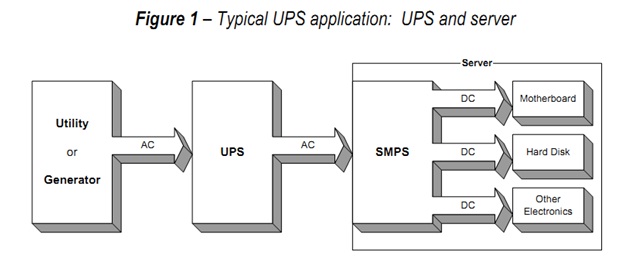
The switching power supply also ensures a stable DC output for components even when the AC input fluctuates or experiences abnormal AC conditions for a short period of time.
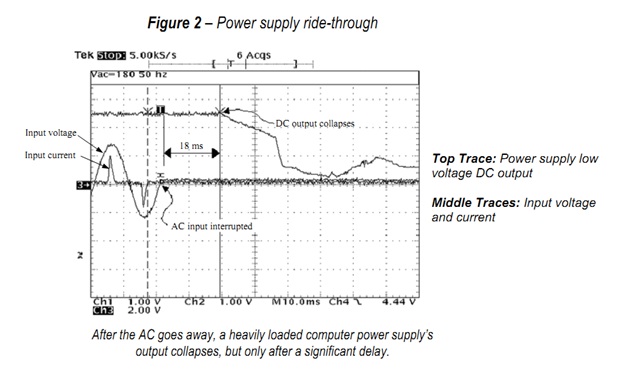
According to research, when the AC power is lost, the SMPS power supply still ensures DC power output for about 18 milliseconds thanks to the energy stored in the filter capacitor of the SMPS switching power supply.
International standard for UPS compatible with devices using SMPS switching power supplies
The figure below illustrates the IEC62040-3 standard, which defines the voltage amplitude limits and allowable disturbance duration of UPS output acceptable to SMPS power sources.
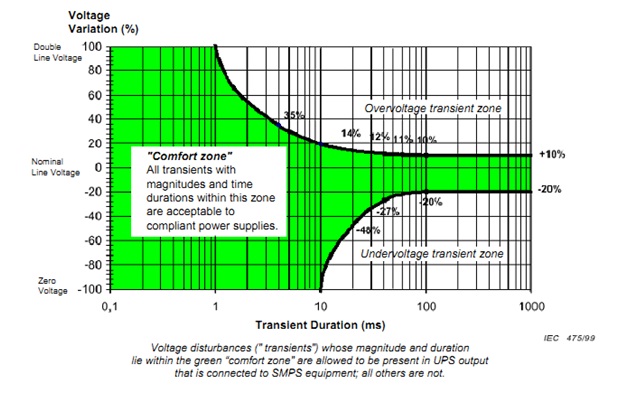
We can see that in the "Comfort Zone", a continuous voltage with an amplitude variation range of -20% to +10% is acceptable
Looking at the diagram, we can see that to be compatible with the UPS output voltage of 230VAC:
- Within 1ms, the UPS output voltage can reach up to 460VAC
- Within 10ms, the UPS output voltage can be 0VDC
- Within a period greater than 100ms, the UPS output voltage can be 230VAC+10% and 230VAC – 20%
UPS Line-Interactive:
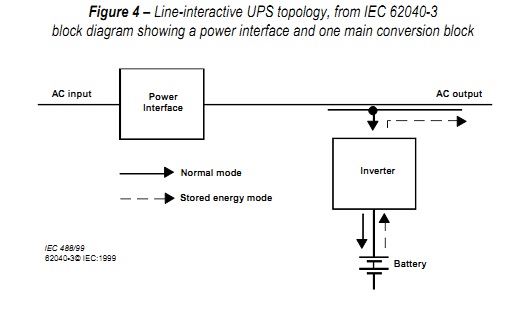
Strengths of the Line-Interactive UPS architecture:
- Lower power consumption (lower operating cost) – Higher efficiency because in AC mode, less conversion is performed (only charging the battery and stopping when the battery is full)
- In theory, reliability is higher due to fewer components and lower heat generation during operation
- Generates less heat from the UPS
Points to note about the Line-Interactive UPS architecture:
In developing countries, the grid voltage is not very stable and fluctuates frequently with a lot of noise, so a Line-Interactive UPS may switch to Inverter mode frequently, because the UPS must maintain its output voltage range — when the grid power is unstable, the UPS switches to Inverter mode, using power converted from the battery. As a result, the battery is used more often, which may require more frequent battery replacement and maintenance.
UPS Online:
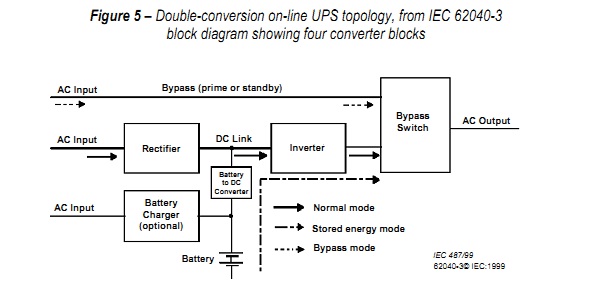
Online UPS topology, due to using more conversion stages,:
- More components and parts
- Higher operating cost and price
- More heat generated due to more components operating
- In theory, reliability is lower due to the use of more components (however, in practice, reliability is also determined by many other factors below)
- Higher energy consumption compared to Line-Interactive. With Double Conversion Online UPS operating continuously, the efficiency is about 85%-92% depending on design and manufacturing, while Line-Interactive UPS is 96-98%. For example, with 90% efficiency, for 1000W consumed, 100W is used by the Online UPS, leading to higher electricity costs, and other costs such as cooling are also higher compared to Line-Interactive UPS.
Advantages of Online UPS:
- Uses less power converted from the battery when the grid power is unstable (because the rectifier contains a DC filter capacitor, so when the input voltage is slightly unstable or noisy, the voltage stored in the capacitor will discharge; therefore, if the grid becomes unstable for a very short time, the UPS will not switch to battery mode since the voltage/energy in the capacitor is still sufficient)
- Has a Power Factor Correction (PFC) regulator for any type of load
- More compact and lighter (especially at high power)
- Can convert output frequency (50Hz to 60Hz and vice versa)
Note:
- In Online double-conversion UPS, components run continuously at higher temperatures, resulting in a shorter lifespan compared to components in Line-Interactive UPS
- Online double-conversion UPS consumes more energy than Line-Interactive UPS because the AC input is converted to DC and then converted back from DC to AC
- Online double-conversion UPS generates more heat into the environment, IT equipment, and even the UPS battery, thereby reducing the lifespan of surrounding equipment
Consideration of Reliability:
In both architectures there are factors that increase or decrease the reliability of the equipment, such as the heat dissipation issue mentioned above. However, in practice, this reliability depends largely on the design, manufacturing, and the quality of the components used by the manufacturer.
Summary:
.png)
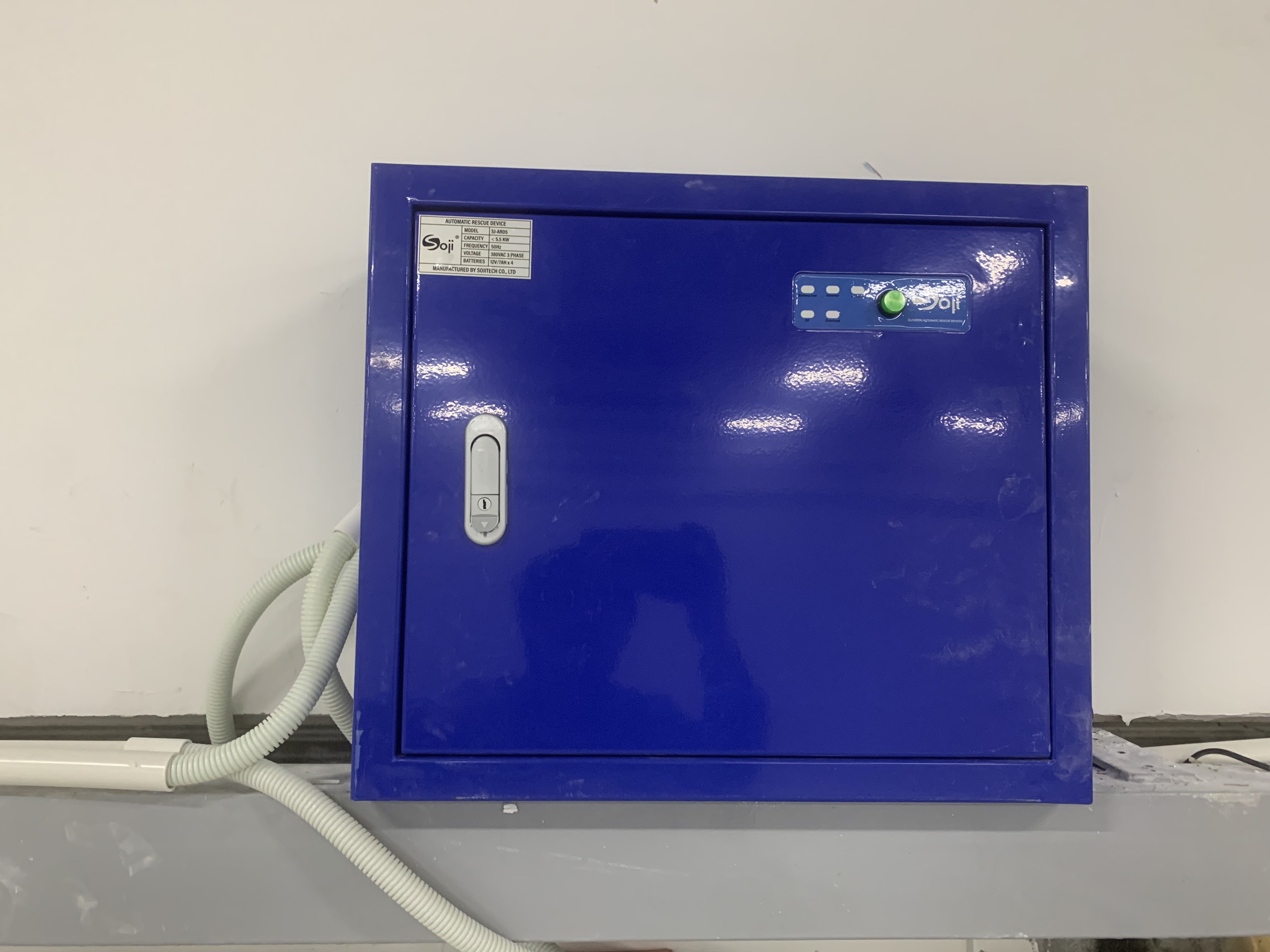
View information SOJI elevator rescue device, Riello UPS
For further consultation on backup power, please contact us!
Tel/Fax: +84 24 7309 9997
Address (Office): No. 10 LK10, Ha Tri Service Land Area, Ha Cau Ward, Ha Dong District, Hanoi City
Website: www.lisatech.vn